

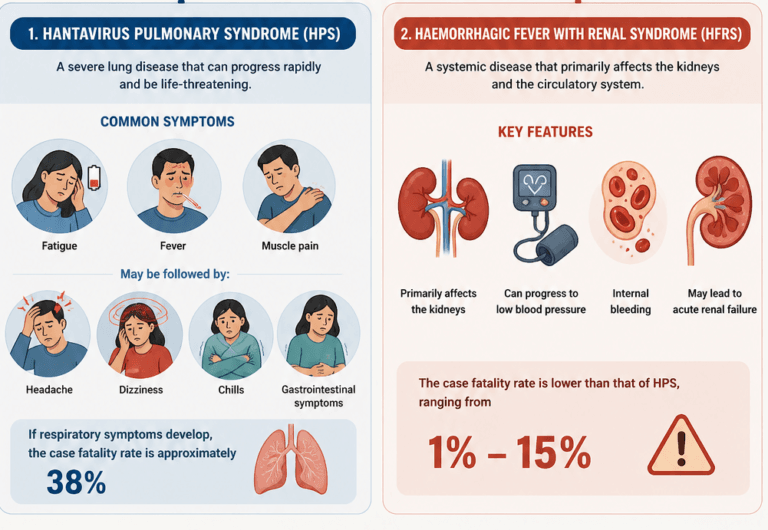
Hantavirus is a zoonosis transmitted to humans primarily through inhalation of particles from the urine, saliva, or faeces of infected rodents, especially when dust or contaminated materials are disturbed. The incubation period is typically between one and six weeks. The virus can cause two serious diseases. The first, Hantavirus Pulmonary Syndrome (HPS), usually begins with fatigue, fever and muscle pain, followed by headache, dizziness, chills and gastrointestinal symptoms. If respiratory symptoms develop, the case fatality rate is approximately 38% for the Sin Nombre virus and up to 50% for the Andes virus in South America. In February 2025, Betsy Arakawa, wife of actor Gene Hackman, died from hantavirus pulmonary syndrome. The second, Haemorrhagic Fever with Renal Syndrome (HFRS), primarily affects the kidneys and can progress to low blood pressure, internal bleeding and acute renal failure with a case fatality rate lower than that of HPS (1% -15%)
According to research published through the US National Institutes of Health, an estimated 150,000 or more cases of haemorrhagic fever with renal syndrome occur worldwide each year, predominantly in Europe and Asia (more than half in China), where distinct Old World hantavirus species such as Hantaan, Seoul and Puumala infect different rodent hosts. Hantavirus pulmonary syndrome, on the other hand, is concentrated in the Americas, where the dominant species are the Andes virus, carried by Oligoryzomys longicaudatus in South America, and Sin Nombre virus, carried by the deer mouse (Peromyscus maniculatus) in North America, each shaped by the distribution of its rodent reservoir.
Hantavirus in Argentina: endemic context
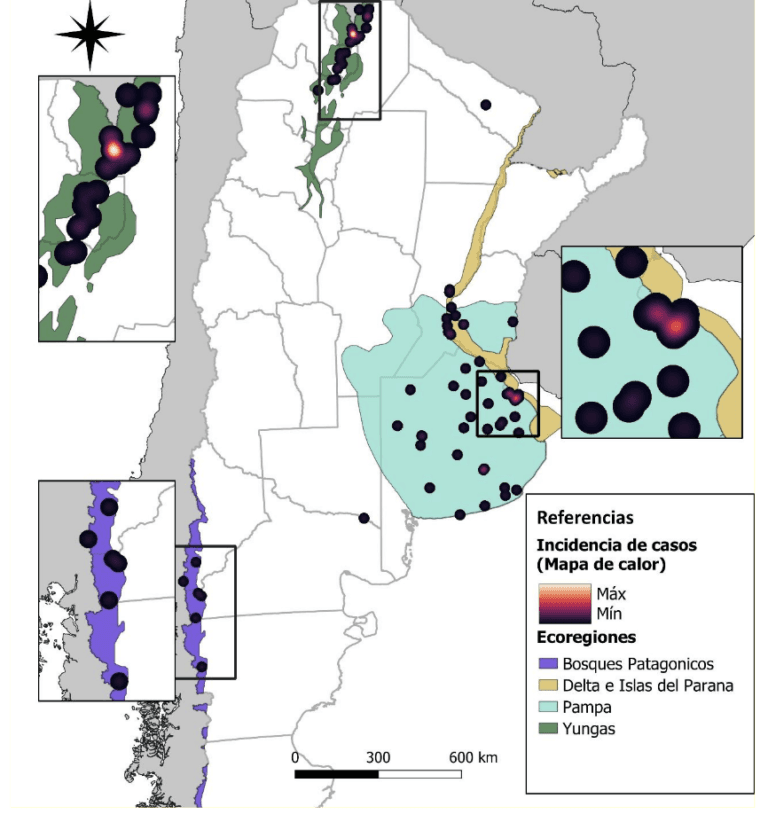
Hantavirus is endemic in several regions of Argentina: the Central region (Buenos Aires, Santa Fe, Entre Ríos), currently the most affected; the Northwest (Salta, Jujuy); the Northeast (Misiones, Chaco, Formosa); and the South, principally the Andean-Patagonian cordillera and forests of Neuquén, Río Negro and Chubut, including areas around Bariloche and Epuyén. In the 2025–2026 season (epidemiological weeks 27/2025 to 16/2026), Argentina recorded 101 confirmed cases, the highest national incidence of the entire analysed period at 0.21 cases per 100,000 inhabitants, with a case fatality rate of 31.7% and a 17% increase compared to the 2020–2024 average. Buenos Aires led in absolute numbers with 42 cases, followed by Salta (30), Santa Fe (7), Jujuy (6), Río Negro (5), Entre Ríos (5) and Chubut (4), with the Southern region recording 10 cases across Neuquén, Río Negro and Chubut. Although no hantavirus cases have ever been recorded in Tierra del Fuego since mandatory surveillance began in 1996, the MV Hondius operated out of Puerto Madryn, Chubut, throughout the 2025–2026 season, a province where hantavirus is endemic.
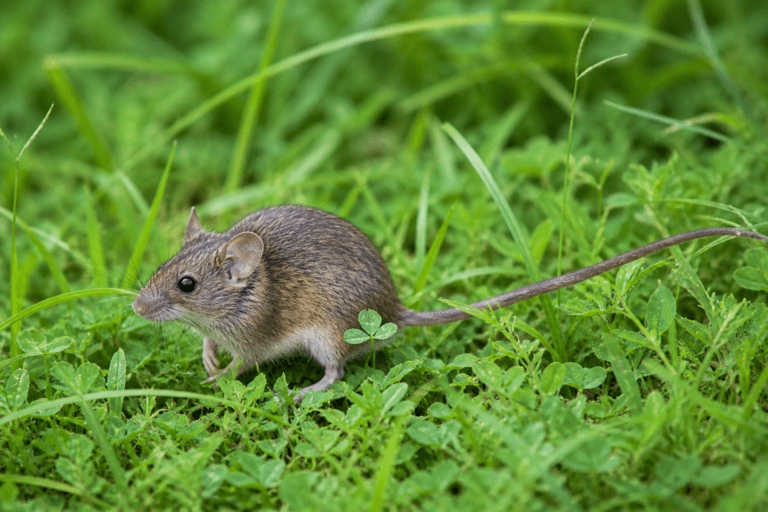
In South America, the long-tailed pygmy rice rat (Oligoryzomys longicaudatus) is the main reservoir of the Andes virus (ANDV, Southern lineage). This rodent is present in Tierra del Fuego and the far south of Patagonia, generally at lower densities than in more northern parts of the cordillera, although periodic population explosions linked to mass flowering of Chusquea cane, mild winters, or years of abundant food increase the potential risk of human transmission.
Oligoryzomys longicaudatus presence in Tierra del Fuego is formally documented in Parque Nacional Tierra del Fuego by Argentina’s official mammal categorisation authority (SAREM), notwithstanding statements by provincial health officials during the 2026 MV Hondius cruise outbreak investigation that the subspecies does not inhabit the region. A well-documented example occurred in 2019 in the Villa La Angostura and Villa Traful area of Neuquén, when mass Chusquea flowering in Nahuel Huapi National Park triggered a major rodent population explosion, captures doubled, and O. longicaudatus became the most abundant species in the area. In the 2025–2026 season, experts link the broader rise in Argentine hantavirus cases to climate change accelerating rodent range expansion: rising temperatures allow reservoir rodents to reproduce in new areas, while drought episodes force them out of their habitats in search of food and water, increasing human contact. Bariloche registered its first human hantavirus case of 2026 in May, highlighting the ongoing risk in northern Patagonia.
Notably, in February 2026, while the MV Hondius was still operating out of Chubut, a household cluster of hantavirus was confirmed in Cerro Centinela, Chubut, where three family members were infected and died. Genetic sequencing showed 99.99% similarity between the three cases. The sequential onset of symptoms among household members was considered consistent with person-to-person transmission, although a common rodent source could not be fully excluded.
| Content | Source |
|---|---|
| Hantavirus transmission, incubation, geographic distribution | WHO Hantavirus Fact Sheet, 2026 |
| HPS case fatality rate Sin Nombre virus (~38%) | CDC MMWR, 2019 |
| HPS case fatality rate Andes virus (up to 50%) | WHO DON599, May 2026 |
| Betsy Arakawa death, February 2025 | Fox 5 DC, March 2025 |
| HFRS global burden (>150,000 cases/year) | Mir et al., Frontiers in Medicine, NIH/PMC, 2022 |
| Old World hantavirus species (Hantaan, Seoul, Puumala) | Muñoz-Leal et al., NIH/PMC, 2019 |
| Rodent reservoir distribution shaping hantavirus geography | NIH/PMC, 2023 |
| Argentina endemic regions; 2025-2026 epidemiological situation | BEN update, Ministerio de Salud Argentina, 2026 |
| 101 cases SE16/2026; incidence 0.21/100,000; CFR 31.7% | BEN 806, Ministerio de Salud Argentina, 2026 |
| 17% increase vs 2020-2024 average; no cases Tierra del Fuego | La Nación, May 2026 |
| Provincial breakdown 2025-2026 (Buenos Aires 42, Salta 30, etc.) | Infobae, May 2026 |
| MV Hondius operating out of Puerto Madryn, Chubut | CruiseMapper, October 2025 |
| O. longicaudatus as ANDV reservoir; Chusquea population dynamics | Carbajo et al., Int J Health Geogr, NIH/PMC, 2009 |
| 2019 rodent population explosion, Villa La Angostura, Nahuel Huapi National Park | La Nación, November 2019 |
| Climate change and rodent range expansion; Bariloche first 2026 case | Diario de Yucatán / AP, May 2026 |
| Hantavirus death in Bariloche, February 2026; Chusquea flowering risk | La Nación, February 2026 |
| Cerro Centinela household cluster; person-to-person transmission | EQS Notas, 2026 |
| Genetic sequencing 99.99% similarity Cerro Centinela | BEN 806, Ministerio de Salud Argentina, 2026 |
© Episphera, 2026. Licensed under CC BY 4.0.