

In April 2026, a cluster of severe acute respiratory illness emerged aboard the MV Hondius, a Dutch expedition cruise ship operating in the South Atlantic. On 2 May 2026, the United Kingdom notified the WHO after laboratory testing in South Africa confirmed hantavirus infection in a British passenger (Case 3). As of 12 May, eleven cases have been reported, including nine laboratory-confirmed infections; three patients have died. All 94 passengers and crew disembarked in Tenerife on 10 May and are being repatriated to their home countries under strict infection control measures. The ship arrived at the port of Granadilla, Tenerife, in the early hours of 10 May for passenger evacuation and repatriation.
The MV Hondius operated as part of Oceanwide Expeditions’ 2025–2026 Antarctic season, departing from Ushuaia, Argentina. The vessel carried 147 passengers and crew from 23 nationalities. The Andes strain has been confirmed as the causative agent, the only hantavirus known to allow limited human-to-human transmission. This is the first hantavirus outbreak ever documented on a cruise ship.
Historical evidence from the largest documented person-to-person Andes virus outbreak (Epuyén, Argentina, 2018-19; 34 cases, 11 deaths) showed that the median reproductive number (the average number of people each infected person goes on to infect) fell from 2.12 to below 1 once case isolation and contact quarantine were enforced, supporting the assessment that a large-scale epidemic is unlikely.
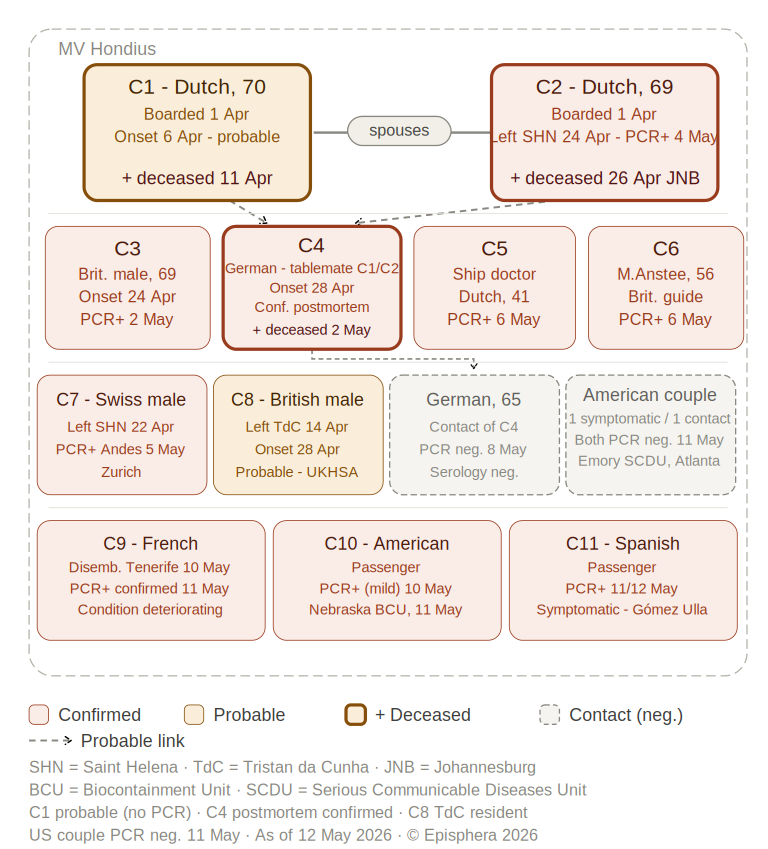
Case Summary
Case 1 (Dutch male, Leo Schilperoord, 70) | Probable: symptom onset 6 April on board. Developed respiratory failure and died on board on 11 April without microbiological confirmation. His body remained in the ship’s morgue for 13 days before being disembarked at Saint Helena on 24 April.
Case 2 (Dutch female, Mirjam Schilperoord-Huisman, 69, wife of Case 1) | Confirmed: disembarked at Saint Helena on 24 April alongside her husband’s body with GI symptoms, and attempted to return home to the Netherlands. Symptoms deteriorated during a connecting flight through Johannesburg on 25 April, and was finally removed from a KLM flight to the Netherlands by the crew due to her medical condition. She died at the hospital on 26 April in Johannesburg. PCR confirmed hantavirus on 4 May.
Case 3 (British male, 69) | Confirmed: symptom onset 24 April, presenting with high fever, shortness of breath and signs of pneumonia. Evacuated from Ascension Island to Johannesburg on 27 April and admitted to ICU. PCR confirmed hantavirus on 2 May; Andes virus confirmed through sequencing. Condition reported as improving as of 7 May.
Case 4 (German female) | Confirmed: symptom onset 28 April with fever and general malaise, later presenting with pneumonia. Died on board 2 May. Postmortem sample collected and sent to the Netherlands with the evacuated patients, where Andes virus was confirmed.
Case 5 (Dutch crew member, 41, ship’s physician) | Confirmed: symptom onset 30 April with fever, fatigue, muscle pain and mild respiratory symptoms. Evacuated to the Netherlands on 6 May. Hospitalised at Radboudumc, Nijmegen; PCR confirmed for Andes virus on 6 May. Currently stable in isolation.
Case 6 (British crew member; Martin Anstee, 56, expedition guide) | Confirmed: symptom onset 27 April with mild respiratory and gastrointestinal symptoms. Evacuated to the Netherlands on 7 May. Hospitalised at Leiden University Medical Center; PCR confirmed for Andes virus on 6 May. Currently stable in isolation.
Case 7 (Swiss male, passenger) | Confirmed: disembarked at Saint Helena on 22 April and flew back to Switzerland on 27–28 April via South Africa and Qatar. Symptom onset 1 May after arrival in Switzerland; immediately self-isolated and reported to local public health authorities. Hospitalised at University Hospital Zurich; PCR confirmed Andes virus on 5 May.
Case 8 (British male, passenger) | Probable: resident on Tristan da Cunha, one of the world’s most remote inhabited islands (pop 250 approx), who was returning home aboard the MV Hondius. disembarked at Tristan da Cunha on 14 April. Symptom onset 28 April. On 9 May, six paratroopers and two clinicians parachuted onto the island with emergency oxygen and medical supplies, the first humanitarian parachute deployment in British military history. No laboratory confirmation as of 11 May 2026.
Case 9 (French national) | Confirmed: disembarked MV Hondius at Tenerife on 10 May, screened as asymptomatic prior to disembarkation. Developed symptoms during the repatriation flight to France; condition worsened overnight. PCR-positive result confirmed.
Case 10 (American, passenger) | Confirmed: evacuated from MV Hondius at Tenerife on 10 May and repatriated on a US government medical flight alongside 17 Americans and one British US resident. PCR-positive result confirmed during the flight on 10 May. He was transferred to the Nebraska Biocontainment Unit at the University of Nebraska Medical Center.
Case 11 (Spanish, passenger) | Confirmed: transferred to the UATAN unit at Hospital Gómez Ulla, Madrid. PCR positive confirmed on 11 May; asymptomatic on arrival. Second PCR positive on 12 May; low-grade fever and mild respiratory symptoms, stable.
Transmission hypotheses
In South America, the long-tailed pygmy rice rat (Oligoryzomys longicaudatus) is the main reservoir of the Andes virus (ANDV, Southern lineage). This rodent is present in Tierra del Fuego and the far south of Patagonia, generally at lower densities than in more northern parts of the cordillera, although periodic population explosions linked to mass flowering of Chusquea cane, mild winters, or years of abundant food increase the potential risk of human transmission. Oceanwide Expeditions has stated that no live rodents have been found on the vessel, although dried excreta can remain infectious for a considerable time.
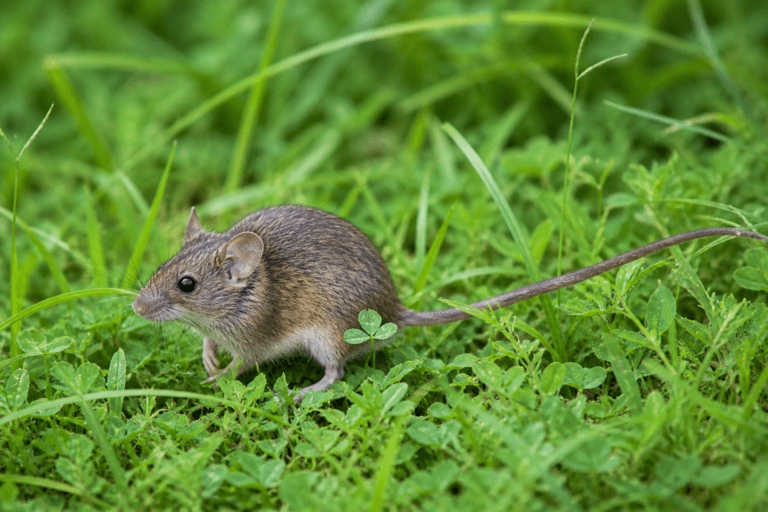
The WHO has stated, based on the incubation period and the timeline of cases, that the most plausible hypothesis was that infection of the first two cases occurred outside the ship. This is consistent with Cases 1 and 2, Dutch ornithologists and lifelong birdwatchers Leo and Mirjam Schilperoord, who developed symptoms just five days after boarding, suggesting they were already incubating when they embarked. The couple had undertaken a four-month road trip through Chile, Uruguay and Argentina from 27 November 2025 to 1 April 2026, travelling through endemic Patagonia during a period of rising rodent populations and increasing hantavirus cases, with birdwatching excursions in areas where O. longicaudatus is present, among them Neuquén and Misiones provinces, both endemic areas for the Andes strain. Argentine investigators have pointed to a visit to the municipal landfill on the outskirts of Ushuaia on 27 March as the most specific exposure hypothesis, a site frequented by birdwatchers for its scavenging birds, though the exact event remains unconfirmed.
Birdwatching fieldwork involves behaviours that could increase transmission risk in rodent-endemic habitats such as steadying a camera or tripod against a rock, or patch of ground contaminated with infected excreta; lying or crouching prone for low-angle shots; handling boots after treading through contaminated vegetation; or resting equipment directly on soil where rodent urine and faeces could concentrate.
That said, a five-day interval does not entirely rule out an onboard source, particularly given that both were around 70 years of age, a group in which a shorter incubation period due to immunosenescence cannot be excluded. The remaining cases appeared over the following three weeks, a pattern more consistent with person-to-person transmission among close contacts than with a persistent environmental source. This includes cabin-mates and medical staff who treated the initial cases without knowing the diagnosis; transmission of the Andes virus between people requires close and sustained contact of this kind. Environmental sampling and genetic sequencing of shipboard material would be the most direct way to resolve this, but by the time the outbreak was formally declared, weeks of cleaning operations had taken place on board. Investigations are ongoing.
Timeline
27 November 2025: Leo Schilperoord (70) and his wife Mirjam Schilperoord-Huisman (69), experienced ornithologists and wildlife photographers, arrive in Argentina and begin a four-month road trip through Argentina, Chile and Uruguay. Their fieldwork involved lying prone on the ground for low-angle shots, working at dawn and dusk when rodents are most active, and entering marginal habitats where O. longicaudatus concentrates.
7 January 2026: The couple cross into Chile after 40 days in Argentina.
31 January 2026: Re-enter Argentina through Neuquén province, one of the endemic areas of the Andes strain.
12 February 2026: Return to Chile. Subsequently cross into Mendoza and begin a 20-day road trip reaching Misiones in northeastern Argentina, also a WHO-identified hantavirus endemic area.
13 March 2026: Cross overland into Uruguay.
27 March 2026: Return to Argentina and travel to Ushuaia. The couple visited a municipal landfill nearby. The site is famous among global birdwatchers hoping to photograph the rare white-throated caracara, a species first documented by Charles Darwin.
1 April 2026: MV Hondius departs Ushuaia with 147 passengers and crew from 23 nationalities. Cases 1 and 2 board the ship.
6 April 2026: Case 1 develops symptoms on board.
11 April 2026: Case 1 dies on board. Cause of death cannot be determined on board. His body is placed in the ship’s morgue.
13–15 April 2026: The MV Hondius visits Tristan da Cunha. Case 8, a British passenger, disembarks on 14 April.
21 April 2026: 23 passengers disembark at Ascension Island and begin returning to their home countries. None are contacted by health authorities until weeks later.
24 April 2026: The ship calls at Saint Helena. The body of Case 1 is disembarked after 13 days in the ship’s morgue. Case 2 disembarks alongside her husband’s body with gastrointestinal symptoms, intending to return home to the Netherlands. 30 passengers disembark in total, including Case 7, the Swiss passenger who later tested positive.
25 April 2026: Case 2 flies from Saint Helena to Johannesburg on the Airlink flight (82 passengers, 6 crew). She then boards KLM flight KL592 at O.R. Tambo International Airport but is removed by the crew due to her medical condition. The flight departs for Amsterdam at 23:15 without her.
26 April 2026: Case 2 dies at a hospital in Johannesburg.
27 April 2026: Case 3, a British passenger who had developed high fever, shortness of breath and signs of pneumonia, is medically evacuated from Ascension Island to Johannesburg and admitted to ICU. The MV Hondius departs Ascension Island.
2 May 2026: Case 4, a German female passenger, dies on board. Cause of death not yet confirmed at this time; subsequently confirmed by postmortem PCR in the Netherlands. The United Kingdom notifies the WHO after laboratory testing in South Africa confirms hantavirus in Case 3. Seven cases are identified at this point.
3 May 2026: The ship docks in Praia, Cape Verde. Local authorities restrict disembarkation.
4 May 2026: PCR posthumously confirms hantavirus in Case 2.
5 May 2026: WHO states that the most plausible hypothesis is that infection occurred outside the ship prior to boarding.
6 May 2026: The Andes strain is confirmed as the causative agent. Case 5 (Martin Anstee) and a 65-year-old German close contact of Case 4 are evacuated from the ship and land at Schiphol; Anstee is transferred to Leiden University Medical Center, the German contact to Düsseldorf. A third evacuation flight carrying Case 6, the ship’s physician, diverts to Gran Canaria following a malfunction in the patient’s life support equipment. A dispute erupts between Spain’s central government and the Canary Islands over docking rights. The Swiss Federal Office of Public Health confirms Case 7, a Swiss passenger treated at University Hospital Zurich. 19:15 CET: The MV Hondius departs Cape Verde heading for the port of Granadilla, Tenerife.
7 May 2026: Case 6 lands in the Netherlands after the Gran Canaria diversion; PCR confirmed positive for hantavirus at Radboudumc, Nijmegen. PCR also confirmed for Case 5 at Leiden University Medical Center, bringing total laboratory-confirmed cases to five.
8 May 2026: The UKHSA identifies Case 8, a British national hospitalised on Tristan da Cunha, as a probable hantavirus case. Spain identifies Case 9, a 31-year-old Spanish female in Alicante with symptoms compatible with hantavirus, transferred to San Juan hospital (she tested negative). WHO officially confirms six laboratory-confirmed cases of the Andes virus out of eight reported cases total.
9 May 2026: With Case 8’s oxygen supplies at critical levels on Tristan da Cunha (the world’s most remote inhabited island), with no airstrip and accessible only by a six-day boat journey, six paratroopers and two military clinicians from 16 Air Assault Brigade parachute onto the island from an RAF A400M after a 6,788 km flight from Brize Norton via Ascension Island, in the first humanitarian parachute deployment in British military history. 3.3 tonnes of medical supplies were airdropped. The patient remains stable and in isolation.
10 May 2026: MV Hondius arrived at Granadilla, Tenerife, Spain. A total of 94 people of 19 nationalities disembarked. French Prime Minister Sébastien Lecornu announced that one of five French passengers repatriated from Tenerife developed symptoms compatible with hantavirus during the return flight to France; all five were placed in strict isolation to undergo diagnostic testing.
11 May 2026: French Health Ministerconfirms PCR-positive result for Case 9; the patient is hospitalised in a specialist infectious diseases unit with deteriorating condition. France has identified 22 contact cases linked to two flights. The US government repatriation flight lands at Eppley Airfield, Omaha, Nebraska; HHS confirms Case 10, an American passenger, mildly PCR-positive, transferred to the Nebraska Biocontainment Unit at UNMC. A second American with mild symptoms was placed in biocontainment. He tested negative. 20 British nationals, one German UK resident, and one Japanese passenger begin 45-day isolation at Arrowe Park Hospital, Wirral. The total number of reported cases rises to eleven, including nine laboratory-confirmed infections. The MV Hondius departs Tenerife for Rotterdam, the Netherlands, for full decontamination, with the body of Case 4 on board.
12 May 2026: Second PCR-positive result for Case 11, the Spanish passenger isolated at the UATAN unit of Hospital Gómez Ulla, Madrid. The patient developed low-grade fever and mild respiratory symptoms overnight but remains stable.
International contact tracing
On the 7th of May, the WHO confirmed that at least 12 countries are monitoring individuals who disembarked from the MV Hondius prior to the outbreak declaration: Canada, Denmark, Germany, the Netherlands, New Zealand, Saint Kitts and Nevis, Singapore, Sweden, Switzerland, Turkey, the United Kingdom and the United States. According to Oceanwide Expeditions, 30 passengers disembarked at Saint Helena on 24 April 2026, including the body of Case 1 and Case 2; Dutch authorities place the figure at approximately 40. Case 7, the Swiss passenger who later tested positive, was also among those who disembarked at Saint Helena.
Contact tracing covers two flights: the Airlink flight from Saint Helena on 25 April (82 passengers and 6 crew) and KLM flight KL592 from Johannesburg to Amsterdam, also on 25 April, whose passengers are being contacted by GGD Kennemerland. Eight French nationals have been identified as close contacts from the Saint Helena flight; one is displaying mild symptoms and is in isolation undergoing testing. In the United States, authorities in at least five states (Arizona, California, Georgia, Texas and Virginia) are monitoring seven returning passengers. Two Singaporean residents aged 65 and 67 who had been on the cruise and on the same Airlink flight as Case 2 were isolated and tested at the National Centre for Infectious Diseases; both tested negative on 8 May. Three people in Canada are self-isolating (two in Ontario, one in Quebec), including one individual who was not on the cruise but shared a return flight with two passengers from the ship. A Dutch KLM flight attendant based in Haarlem was hospitalised in isolation at Amsterdam UMC with mild symptoms following exposure on flight KL592 on 25 April and tested negative on 8 May.
In Spain, three contacts linked to flight KL592 have been identified. A woman seated two rows behind Case 2 developed symptoms compatible with hantavirus, primarily cough, at her home in Alicante and was transferred preventively to hospital on 8 May. She tested negative on the 9th of May. A woman resident in Catalonia, asymptomatic, was identified after investigation revealed she had changed seats during the flight, which had initially prevented her from being traced; she is under mandatory quarantine in a Catalan hospital. A South African national who also travelled on KL592 spent one week in Barcelona before returning to her country; she is asymptomatic, stayed alone in a hotel without close contacts, and is being monitored by South African health authorities.
| Content | Source |
|---|---|
| MV Hondius outbreak: confirmed cases, deaths, ICU, case details | WHO DON600, May 2026 |
| Route and timeline of MV Hondius | Oceanwide Expeditions, May 2026 |
| Andes strain confirmed; human-to-human transmission | WHO DON600, May 2026 |
| Diplomatic dispute; Spain, Canary Islands, Cape Verde | 20 Minutos, May 2026 |
| Case 7 confirmed in Switzerland | 20 Minutos, May 2026 |
| Medical evacuation; three patients to Netherlands | Rijksoverheid, May 2026 |
| WHO working hypothesis: infection outside ship; person-to-person transmission | WHO, May 2026 |
| Hantavirus: transmission, incubation, clinical presentation, geographic distribution | WHO Hantavirus Fact Sheet |
| HPS case fatality rate Sin Nombre virus (~38%) | CDC MMWR, 2019 [link needed] |
| HPS case fatality rate Andes virus (up to 38%) | WHO DON600, May 2026 |
| Betsy Arakawa, February 2025 | Fox 5 DC, March 2025 [link needed] |
| HFRS global burden (>150,000 cases/year) | Mir, Frontiers in Medicine, 2022 [link needed] |
| Endemic regions in Argentina; 2025-2026 national cases | Infobae / BEN 806, 2026 |
| O. longicaudatus as ANDV reservoir; Chusquea and population dynamics | Carbajo et al., Int J Health Geogr, 2009 [link needed] |
| No cases in Tierra del Fuego; 2025-2026 southern Patagonia situation | La Nación, May 2026 [link needed] |
| MV Hondius expedition vessel | CruiseMapper, October 2025 |
| Cerro Centinela household cluster | EQS Notas, 2026 [link needed] |
© Episphera, 2026. Licensed under CC BY 4.0.